About the book
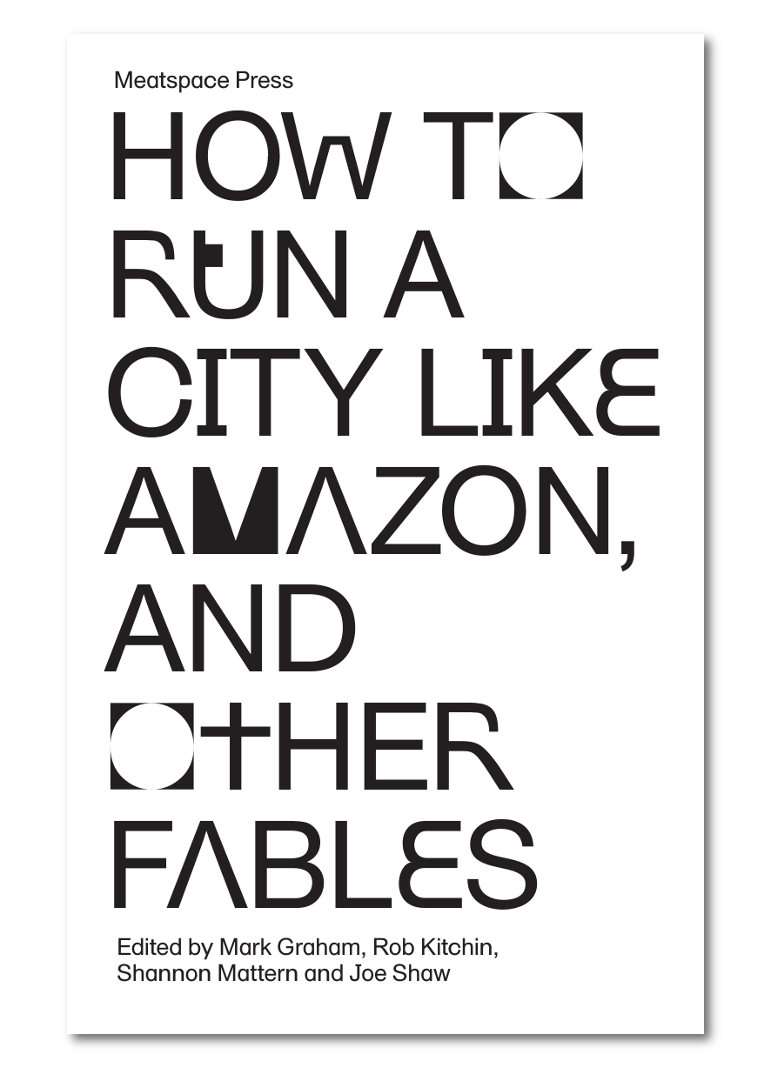
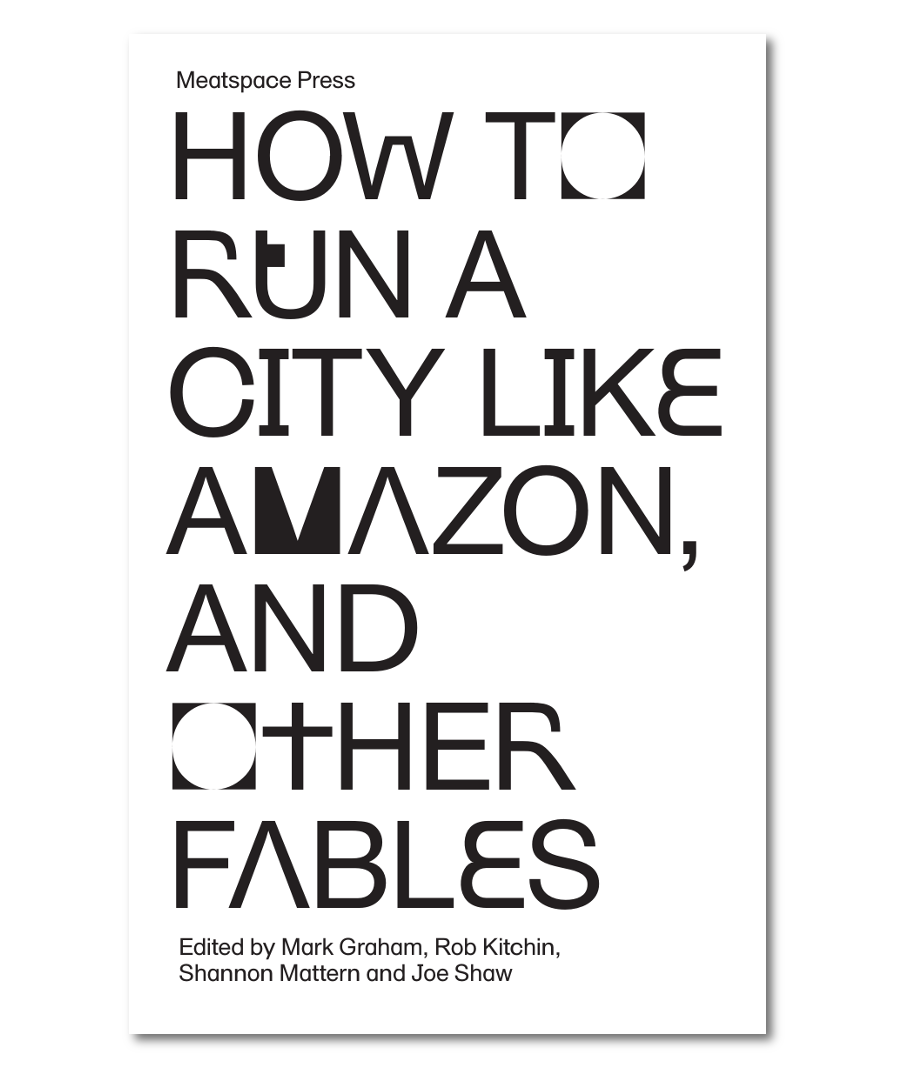
What operating system does your city run on? After many months in the making, we are excited to announce the publication of our first book: How to Run a City Like Amazon, and Other Fables Please visit our shop for a limited run of paperback copies, and various digital download formats (pdf, epub, mobi, azw, azw3).
The idea behind the book is to ask what would it be like to live in a city administered using the business model of Amazon (or Apple, IKEA, Pornhub, Spotify, Tinder, Uber, and more), or a city where critical public services are delivered by these companies?
With 44 contributing authors and 38 chapters, the book playfully combines speculative fiction and analysis of 38 different business models and practices when applied to running our cities of the future. The book was edited by Mark Graham, Rob Kitchin, Shannon Mattern and Joe Shaw. The design and artwork was lovingly undertaken by the talents of Carlos Romo-Melgar and John Philip Sage.
A limited print run of the book is available in our shop now, including as a digital download (with ebook formats). Please share with your friends and colleagues on social media and beyond. Any questions, get in touch!
Should cities be run like businesses? Should city services and infrastructure be run by businesses? For some urban commentators, policy-makers, politicians and corporate lobby groups, the answer is ‘yes’ to both questions. Others are critical of such views, cautious about shifting the culture of city administration from management to entrepreneurship, and transforming public assets and services run for the common good into markets run for profit. The stories and essays in this book explore how a city might look, feel and function if the business models, practices and technologies of 38 different companies were applied to the running of cities. They ask: what would it be like to live in a city administered using the business model of Amazon (or Apple, IKEA, Pornhub, Spotify, Tinder, Uber, etc.) or a city where critical public services are delivered by these companies? Collectively, the chapters ask us to imagine and reflect on what kind of cities we want to live in and how they should be managed and governed.
Contributors:
Manuel B. Aalbers, Tooran Alizadeh, James Ash, Sarah Barns, Gavin Brown, Ryan Burns, Matthew Claudel, Jeremy W. Crampton, Ayona Datta, Martin Dodge, Leighton Evans, Jessica Foley, Jennifer Gabrys, Mark Graham, Tony H. Grubesic, Edward Helderop, Kara C. Hoover, Andrew Iliadis, Kurt Iveson, Glenn Kaufmann, Rob Kitchin, Agnieszka Leszczynski, Sophia Maalsen, Shannon Mattern, Harvey J. Miller, Cian O’Callaghan, Nancy Odendaal, Dietmar Offenhuber, Alison Powell, Lizzie Richardson, Gillian Rose, Jathan Sadowski, Kalpana Shankar, Joe Shaw, Harrison Smith, Monica Stephens, Linnet Taylor, Jim Thatcher, Pip Thornton, Anthony Vanky, Alberto Vanolo, Alan Wiig, Katharine Willis, Matthew Zook.
Edited by Mark Graham, Rob Kitchin, Shannon Mattern and Joe Shaw, with forty-four contributors spanning geography, urban studies, architecture, media, design and related fields.